





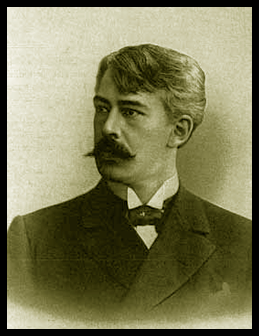
(17 January 1863 - 7 August 1938), was a Russian actor and director.
He was the first person to create a coherent and usable "system" so that actors could repeat interesting and inspired performances.
People who have seen great theatre and remember the inspired moments often think that it is the actor's job to create those moments. This is a fallacy, because those moments aren't under anyone's control.
Stanislavski's method, in a nutshell: emotions are produced through the use of actions.
The system is the result of Stanislavski's many years of efforts to determine how someone can control in performance the most intangible and uncontrollable aspects of human behavior, such as emotions and art inspiration.
Stanislavski noticed that even the greatest actors in Russia had nights of inspiration, when they were totally in the role, and other nights were only just accurate. He also saw how inexperience or untrained actors tended to portray false moments -- aspects of behavior that an audience can detect. This, typically, comes from the very natural human urge to have an emotion first, and then have the emotion trigger the action. Inexperienced actors attempt to force an emotion onto a scene, and a forced emotion reads as dishonest.
Stanislavski reversed the natural human reaction of the emotion causing the action and stressed that, on stage, the action should come first and the emotion will follow.
Stanislavski's method is different from Method actors, a group that started in New York in the 30's and 40's. They use an actor's personal experience to generate emotional responses and try to "live the role."
The problem with Method Acting is that it is equally unreliable. If you use the memory of your grandmother's funeral to illicit a sad emotion, the day will come when you will have internally resolved the issue and the sadness won't come.
A method based on the teachings of Stanislavski, called Practical Aesthetics, is what we'll study in this class.

Before we dive into the method, let's discuss a few preliminary ideas from the school of Practical Aesthetics:
1. Being honest with yourself is crucial, and extremely difficult
An actor must have the courage to look at themselves honestly to see what strengths they have as a performer and what weaknesses they have as a performer. It is then their job to work on all the weak aspects that are in their control and not worry about those things that are not. The actor's job is, simply: to be in the best condition possible to do the required performance.
2. Talent does not exist
And if it does, you either have it or you don't and can't really change it. So why worry about it? The only real talent in acting (or in the arts, or in anything else in the world) is a talent for working. Anyone can act if they have the will to do so, and anyone who says they want to but don't have the knack for it suffers from a lack of will, not a lack of talent.

PHYSICAL ACTION
An actor must always have something specific to do onstage or they will immediately stop acting. That's why physical action is so important for the actor. An action is the physical pursuance of a specific goal. Choosing a good action is an invaluable skill that can only developed with lots of practice and hard work.
AN ACTION MUST:
1. Be physically capable of being done
2. Be fun to do
3. Be specific
4. Have its test in the other person
5. Not be an errand
6. Not presuppose any physical or emotional state
7. Not be manipulative
8. Have a "cap"
9. Be in line with the intentions of the playwright
1. An action must be physically capable of being done.
"Pleading for help" is something that you can begin to do immediately. "Pursuing the American dream" is not something you can pick up and do at a moment's notice. That's not to say an action has to involve intense physical activity like jumping up and down. You can be "pleading for help" while sitting still in a chair.
An action must be something that you, the actor, can actually accomplish onstage.
2. An Action must be fun to do.
As you will learn, any number of actions can be correct for a particular scene. Common sense dictates that you decide on one that you, as an actor, will want to do, since you will be the one doing it. Fun doesn't necessarily mean something that will make you laugh but rather something that is compelling to you. Language is your tool here: you should use vital, active, gutsy words that will inspire you to want to do this action.
"To get someone to give me information" is a good, playable action, but it may not be as compelling as "convince an enemy to reveal a dark secret."
3. An action must be specific.
Stanislavski said, "Generality is the enemy of all art." If your action is general, then everything you do onstage will be general. The specificity of an action like "extracting a crucial answer" will bring you much more to life than the vagueness of "finding out something."
4. The test of the action must be in the other person.
An action is the pursuance of a specific goal, and that goal must have to do with the other person. In other words, looking at your partner, you should be able to tell how close you are to completing your action. This also makes you less self-conscious and allows you to concentrate on something way more interesting than how well you're performing. If your action is "forcing an enemy to do my bidding," at any moment you should be able to tell how close he is to doing your bidding, and only when he's done your bidding will you have completed the action.
5. An action cannot be an errand.
An errand is an action that has no test in the other person. "Delivering a message" is not a good action because you do not have to look at your partner to know if you've completed it or not. Also, it can be completed in a line, which leaves you with nothing to do for the rest of the scene. However, if your action is "to impress an important superior," even if you have no dialogue, you still have an interesting action to play.
6. An action cannot presuppose any physical or emotional state -- either in you or in your partner.
You can't artificially induce a physical or emotional state (ex: hunger, anger, sorrow, drunkenness), because those feelings are not within your control. Any action that forces you to assume one of these states will force you to act a lie, the truth being that you are not in those states. If you try to work yourself up into the state for a scene, then your concentration will be on maintaining that state and not on your action.
"Making a jerk know how mad I am" is not a good action because you can't do it unless you are angry. A better action would be "Putting a jerk in his place."
7. An action cannot be manipulative.
A manipulative action is one chosen to produce a desired effect on your partner. This type of action leads to a scene where you've planned what you're going to do, no matter what your partner is doing onstage. "Making a friend cry" is a manipulative action. A better action would be "Forcing a friend to face facts." A manipulative action can cause you to act in a predetermined way instead of dealing truthfully with what is happening on stage.
8. The action must have a cap.
The cap is the specific thing you are looking for to know if you have succeeded with your action. You have to be able to know if you are finished with your action by looking at the other person. For example "To get a friend's forgiveness" is an action with a cap. You know when your partner has forgiven you by their behavior toward you. An action like "Maintaining someone's interest" does not have a cap. You must always have a specific end to work toward onstage.
9. The action must be in line with the intentions of the playwright.
In Die Hard, when John McClane's character has a face-off with Gruber, if Bruce Willis had chosen the action "Plead with a friend for forgiveness," that action would clearly be out of whack with the intentions of the playwright. As interesting an action as it may be, it has to be true to the author's intentions.
For the purposes of classwork and oftentimes during the rehearsal process, though, it can be fun and even extremely revealing to occasionally break this rule. Playing an opposite action to the scene's normal intention might show you something completely new that you never thought of before.
SCRIPT ANALYSIS, PART 1
1. What is the character literally doing?
Be as literal as possible; don't embellish what is happening. Find out the one specific thing he is doing that encompasses every line.
Example: A man enters a room, reaches for his pipe, searches for a tobacco pouch, takes his tobacco pouch from the desk drawer, opens the pouch, fills the pipe, and takes out matches. What the character is literally doing is preparing to smoke his pipe. Even if he puts on music, that doesn't interfere with what he is literally doing.
Some people call the literal action the popcorn moment. If you're at the movies with your friend and he goes to get popcorn, when he comes back, he might ask you, "Hey, what'd I miss?" "Well, Romeo proposed to Juliet." That's another way to think about getting to the literal action of a scene.
2. What is the essential action of what the character is doing in this scene?
Once you know what the character is literally doing, the next step is choosing the essential action of what the character is doing.
If the literal action of a scene is: Joe is getting Susan to dump Frank and become his girl.
The essential action of that scene is: Making a loved one take a big chance.
Here are a few strong, playable essential actions to get you started:
Intimidate a bully into backing off
Protect a weaker person from danger
Impress a superior
Show a subordinate who's boss
Extract a crucial answer
Threaten someone into behaving
Putting a jerk in his place
Pleading with a strict guy for a break
Making a liar admit the truth
COMING SOON IN PART 2: TACTICS!